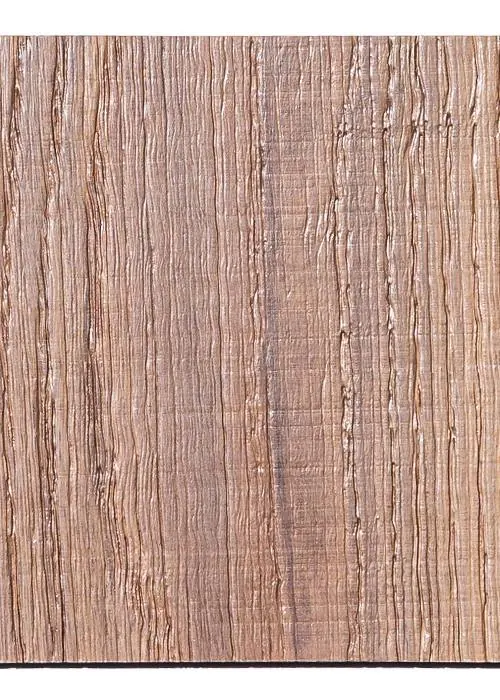
Every sheet of textured veneer leaves our floor one of four ways: raw, prefinished, stained, or painted. Which one you pick shapes the install schedule, the final look, and how much control your own finisher keeps. There’s no wrong answer, but there’s usually a right one for the specific job.
Raw is the choice when the project has a finish standard of its own. A designer with a whole-house stain schedule, a millwork shop matching an existing run, a builder whose painter finishes everything on site so it all cures under the same roof. Raw material gives your finisher the full say. Texture takes stain differently than flat stock, the scored grain pulls more pigment and reads darker in the cuts, so have your finisher test on an offcut before committing the wall.
Prefinished flips the trade. You give up on-site control and get consistency and speed. The finish goes on in the shop, under controlled conditions, before the material ever sees a job site, which matters on projects where the schedule is tight or the site conditions are dusty, cold, or otherwise hostile to a good finish. Panels arrive ready to hang.
Stained at the mill sits between the two. You pick the tone, we put it on, and the batch comes out even because the same line handles every piece. Painted does the same for opaque color, and paint on texture is an underrated look: the pattern keeps working through the color, so you get depth without wood tone, which suits modern interiors that want texture but not brown.
Two details that separate a professional result from a near miss. First, edgebanding: we cut it textured to match, so a panel’s edge carries the same pattern as its face. Order it with the panels, in the same finish path, and cabinet fronts and shelving stop looking like veneer and start looking like solid stock. Second, batch matching: order the full scope at once when you can. Our mill sizes, drills, and textures a batch in one pass, which is what keeps a kitchen’s worth of fronts, or a wall’s worth of panels, consistent from first piece to last.
The Hardwoods page covers the material itself, and the FAQ answers the spec questions finishers ask. When you’re ready to see finish on texture in person, request a sample.