
Craftsmanship & Engineering
How one roof in Rigby, Idaho does milling, texturing, and finishing that most shops split across four vendors.
Get the Rigby facility capacity sheet, equipment list, and lead times for volume orders.
Updated September 2, 2026. Reviewed on a quarterly cadence.
One Roof, Start to Finish
Most companies in this category do one thing. They mill wood, or they build cabinets, or they engineer hardware, and they buy the rest from somewhere else. Snake River Hardwoods does the whole run in one building on the Snake River in Rigby, Idaho.
Timber comes in by the board foot from trusted suppliers. Snake River Hardwoods is a hardwood processor, not a forest owner. It doesn’t harvest timber and doesn’t claim to. What it does is take good lumber and take it further than most shops can: milling, texture engineering, sizing, drilling, and finishing, all under one roof, by people who’ve been running hardwood on that same floor for thirty years.
That’s the whole point of owning the process end to end. Mechanical engineering (the hardware that makes a hidden door swing or a floating shelf hold weight), structural engineering (the core and joinery that keep a panel flat for decades), and design engineering (the texture, the grain, the finish a person actually sees and touches) all happen under the same roof, by the same team, instead of getting handed off between four different vendors in four different states.
The Rigby, Idaho Facility
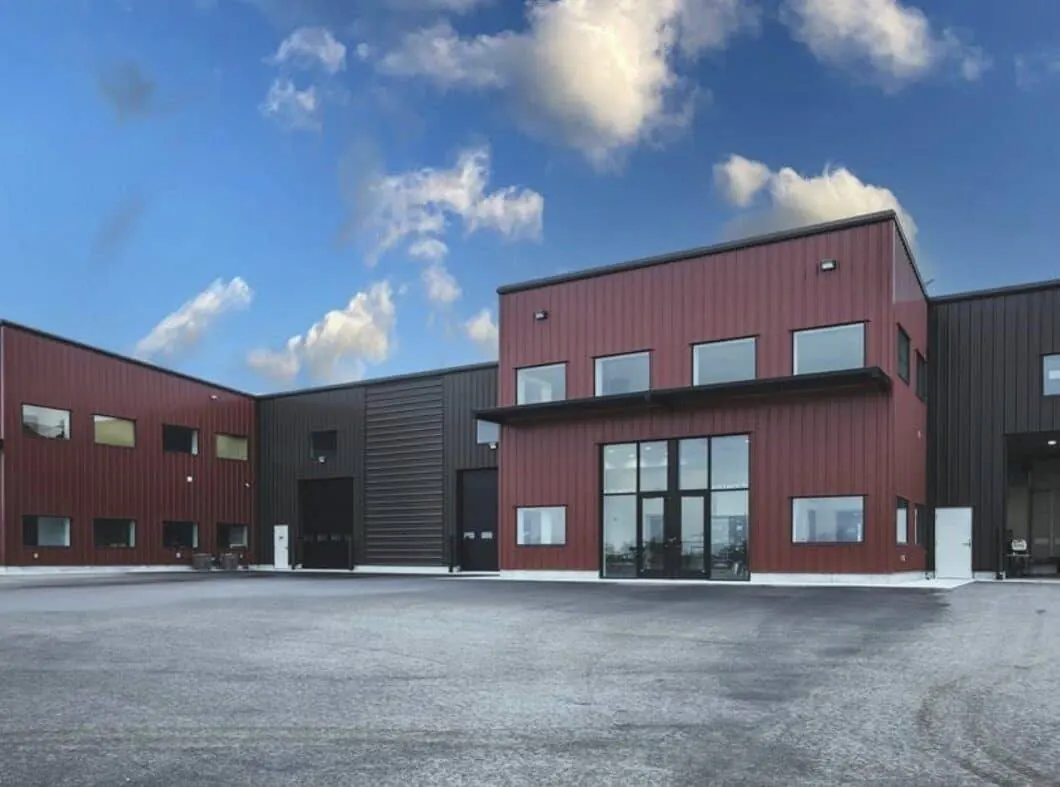
In 2026, Murphy Door® acquired a thirty year old hardwood processor’s facility in Rigby, Idaho: 22,500 square feet, sitting on the Snake River, with a team of about a dozen people that’s been growing since. The purchase was $3.25 million. It’s public record, reported by the Post Register and announced by Murphy Door® itself.
This wasn’t a company buying a building. It was a company buying thirty years of people who already knew how to run hardwood right, on a river that gave the new brand its name: Snake River Hardwoods.
A Coming Home Story
Here’s the part that isn’t marketing spin. The founder of the Rigby facility helped build Murphy Door®’s very first product, more than thirteen years ago. That’s a matter of record in Murphy Door®’s own public history, not a line written for this page.
Thirteen years later, that same craftsman’s facility is now part of the same company again, this time as the material engine behind Snake River Hardwoods. The people who helped start Murphy Door® are the same people running the mill that supplies it. Murphy Door®'s founding story, in full ›
The Equipment, Named and Explained
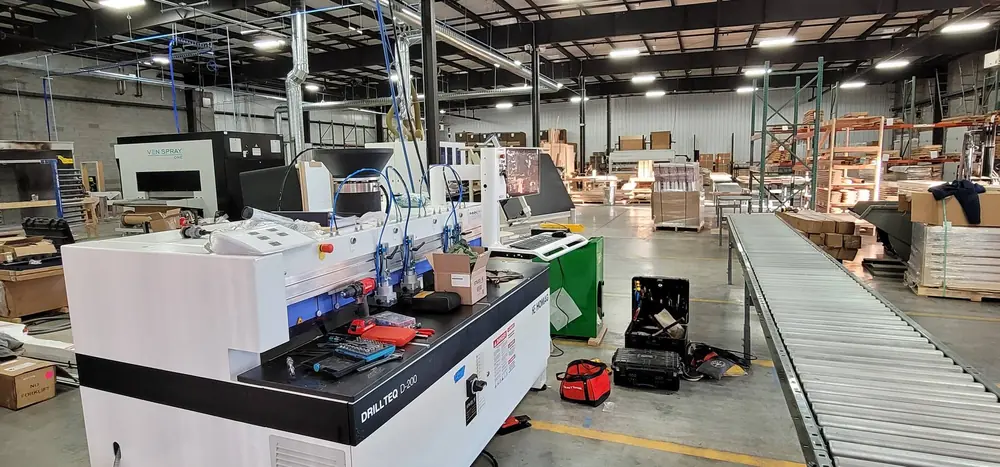
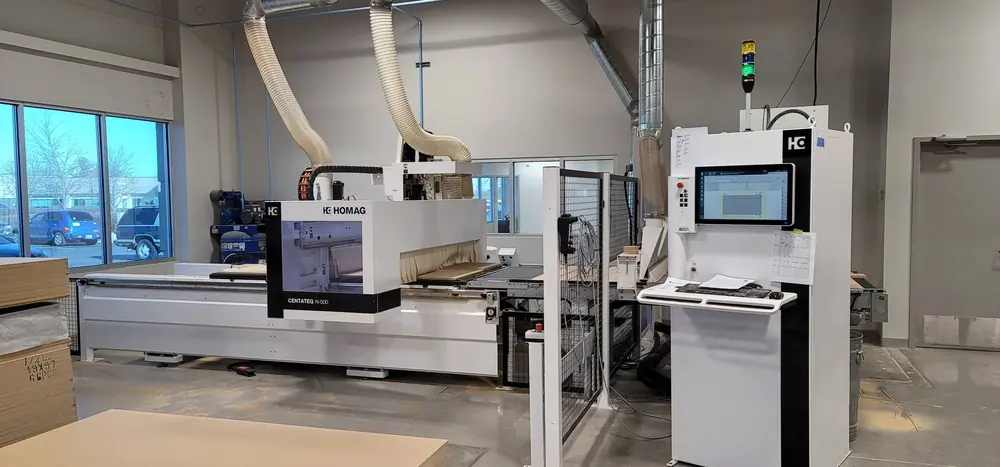
Three machines do the heavy lifting at Rigby, and they do different jobs. None of them is a stand-in for the others, and none of them is the whole story by itself.
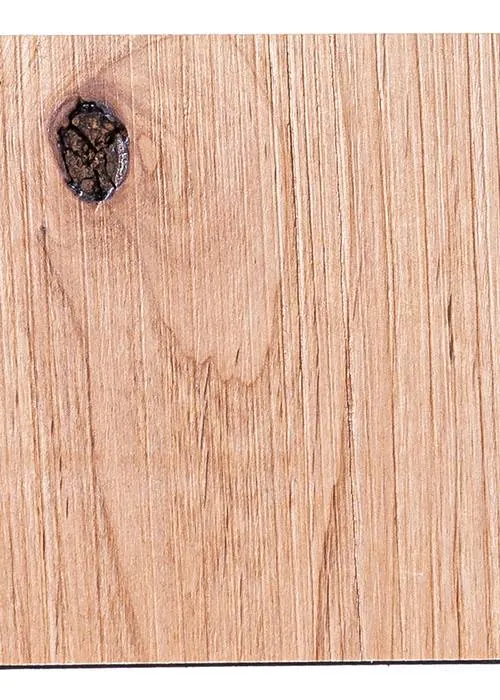
The Heesemann texturing machine. Built by Karl Heesemann Maschinenfabrik, this machine handles the cross-scoring and texturing that turns flat hardwood, veneer, or exterior siding into a surface with real depth and grain movement. This is the machine behind the T3D texture lines: Driftwood, Milled, Weathered, Antique, and the rest.
The custom 5-axis BAACI mill. This is a different machine entirely: a multi-tooled, 5-axis mill built by BAACI to Snake River Hardwoods’ own specifications. It’s not off the shelf. It runs multiple pieces of product at once on a single machine, texturing, sizing, and drilling several pieces simultaneously instead of one at a time. That’s the difference between a shop that processes wood piece by piece and one that can run a real production volume without cutting corners on any single piece.
The Venjakob finish line. Finishing runs on a Venjakob coating line out of Germany, a conveyor-fed spray system built for wood components at production volume rather than a hand-held gun in a booth. It runs our prefinished, stained, and painted options with speed and gun settings stored by recipe, so a stain match or paint spec we’ve run before doesn’t get re-dialed in by hand each time. Texture and finish both come off equipment, not off whoever is holding the sprayer that day.
Together, these three machines are why Snake River Hardwoods is one of the few U.S. mills purpose-built for architectural-scale hardwood specification. Every one of them is named, on the floor in Rigby, and available to walk. See how the Heesemann, BAACI, and Venjakob equipment applies to specific product lines ›
The Family of Companies
Snake River Hardwoods sits inside a bigger structure, and it’s worth being straight about how the pieces fit.
Murphy Door® Inc. is the parent company: the hidden door business that also builds Murphy Beds and wall beds, concealment furniture, and its own hardware line. Snake River Hardwoods is a Murphy Door® company, built around the Rigby facility, supplying hardwood, textured siding and veneer, and floating shelf products. T3D Textured Woods and Ultra Shelf are product lines under Snake River Hardwoods: T3D is the texture engineering technology itself, and Ultra Shelf is Snake River Hardwoods’ retail shelf and mantel brand, built on top of it.
Full Murphy Door® family story › · Ultra Shelf product line ›
A Material Standard We Build On: Vaultwood Core™
Vaultwood Core™ is not a Murphy Door® company. It’s a specification, not a factory, and not something we own: a third-party standard we spec and buy to. Vaultwood Core™ doesn’t manufacture anything itself. It’s a licensed material standard that qualified suppliers build to, the same way an ingredient brand certifies what’s inside a finished product without making that product.
Snake River Hardwoods uses Vaultwood Core™ as the core substrate under some of its engineered veneer products, the ones built as hardwood veneer over an engineered core rather than solid wood through and through. Not every product. Solid hardwood pieces don’t need it. Engineered veneer panels that have to stay flat across seasons of humidity and temperature swings are where a specified core standard like this earns its place.
| Spec | Published Figure |
|---|---|
| Density | 45 to 49 lb/ft³ |
| Modulus of rupture | 4,500 to 5,500 psi typical (4,000 psi licensing floor), tested per ASTM D1037 |
| Face screw hold | 275 to 350 lbf |
| Edge screw withdrawal | 225 to 285 lbf |
| Modulus of elasticity | ~450,000 to 500,000 psi |
| Internal bond | ≥ ~90 psi |
| Compliance | ANSI A208.2 moisture/dimensional stability; EPA TSCA Title VI and CARB Phase 2 formaldehyde; NAF options available |
The Vaultwood Core™ third-party material standard team puts it plainly: they don’t claim to be a neutral certifier, because the brand owner also builds finished products, and every number they publish is cited or it doesn’t go on the site. That’s the same standard this page tries to hold itself to. Full spec sheet at vaultwoodcore.com.
Where This Fits in a Project
Architects and designers pulling specs, and builders comparing an engineered core against solid wood or plywood, can get the full material comparison and product specs directly from Snake River Hardwoods. Request spec sheets and sample kits ›